
The Creamy Clean Eating Salad That Actually Kills Your Lunch Carb Cravings (No Sad Bowls Here)
Prep Time: 15 minutes | Cook Time: 5 minutes | Total Time: 20 minutes | Serves: 2–3
You made the salad. You ate the salad. And by 2:17pm you were standing in front of the pantry, staring at a sleeve of crackers like they personally owed you something. That is not a willpower problem — that is a structural problem. Most clean eating salads are built like decoration: beautiful, photogenic, and completely incapable of keeping you full past noon. This bowl is engineered differently. Every layer — the greens, the protein, the dressing — is chosen with one non-negotiable goal: to keep you satisfied, focused, and completely uninterested in the bread basket until dinner. No iceberg. No watery vinaigrette. No quiet regret.
Kitchen Trial Note
When I first built this salad on a Sunday afternoon, I was genuinely skeptical. My husband had declared a quiet war on “rabbit food,” and I had exactly zero interest in eating something that felt like a punishment. I massaged the kale, whisked the tahini dressing until it turned glossy and thick, roasted the chickpeas until they blistered at the edges, and assembled the whole bowl in under twenty minutes. He ate it without commentary — which, in our kitchen, is the highest form of praise — and then asked for it again on Wednesday. It has been in our weekly rotation ever since, and it has never once wilted in the fridge before Friday.
What “Clean Eating” Actually Means in This Bowl
Clean eating is not a synonym for flavorless. In this context, it means ingredient intentionality — every component earns its place by delivering either nutrients, satiety, or flavor (ideally all three). There are no processed dressings made of seventeen unpronounceable ingredients. There are no inflammatory fillers pretending to be food. What you get instead is maximum nutrient density per bite, built from whole foods that your body actually recognizes and uses efficiently.
The Satiety Science — Why This Bowl Actually Fills You Up
The reason this salad satisfies when others fail comes down to the macronutrient trio working in concert: healthy fat from the tahini, plant protein from the chickpeas, and soluble fiber from the kale and seeds. Fat slows gastric emptying. Protein triggers satiety hormones. Fiber feeds the gut microbiome and regulates blood sugar. When all three operate together, your hunger signal stays quiet for hours — not because you overate, but because your body received exactly what it needed.
Why Most Clean Salads Fail by Wednesday
The real enemy is architecture. Most clean salads fail for three predictable reasons: a watery dressing that pools at the bottom and turns everything soggy, a low-protein base that offers volume without satiety, and iceberg or baby spinach that collapses within twenty-four hours of dressing contact. This bowl fixes all three. The dressing emulsifies. The greens resist. The protein delivers. That is the gap between what ranks on Pinterest and what actually works in a real refrigerator on a real Thursday.
The Formula: Every Layer Explained
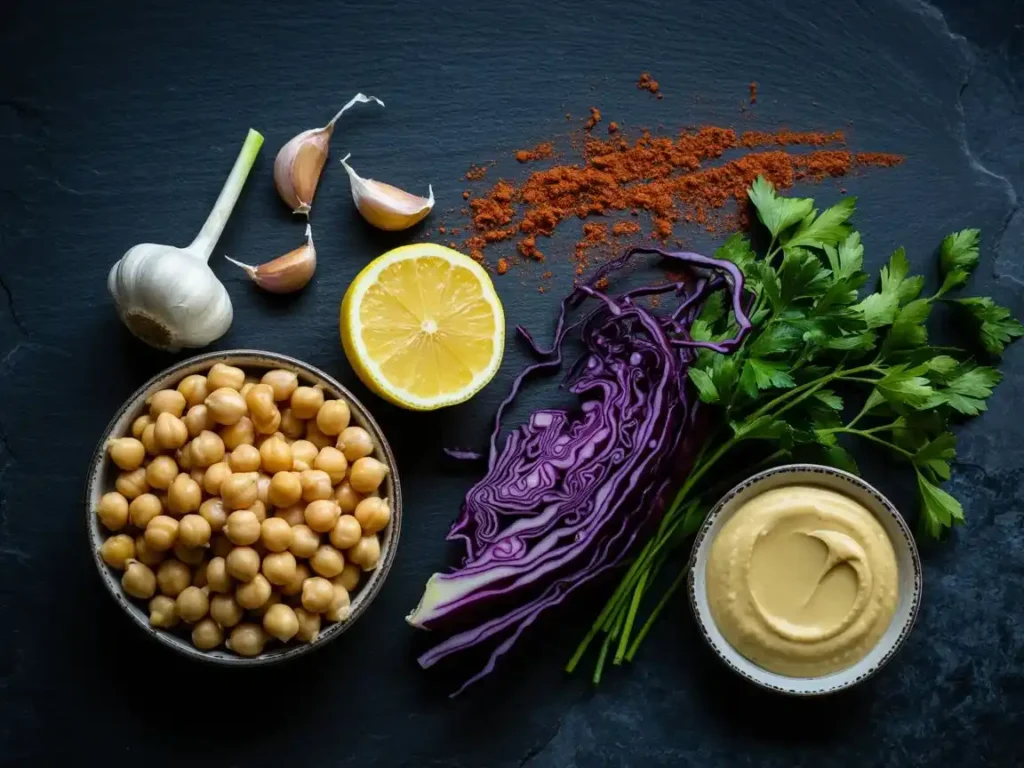
The Creamy Dressing — The Star The dressing begins with tahini as the fat base. Whisk it together with fresh lemon juice, one raw garlic clove grated on a microplane, a half-teaspoon of apple cider vinegar, a pinch of salt, and two to three tablespoons of cold water added gradually until the mixture emulsifies into a thick, pourable consistency. The emulsification is critical — you are creating a coating, not a liquid. It should cling to a spoon and hold its shape.
The Base — Greens That Survive Friday Massaged kale or finely shredded purple cabbage forms the structural foundation. Both hold their texture for up to five days in the refrigerator, which makes them the only logical choice for a meal-prep salad. Arugula and baby spinach are beautiful. They are also structurally unreliable after 6pm on the day you make them.
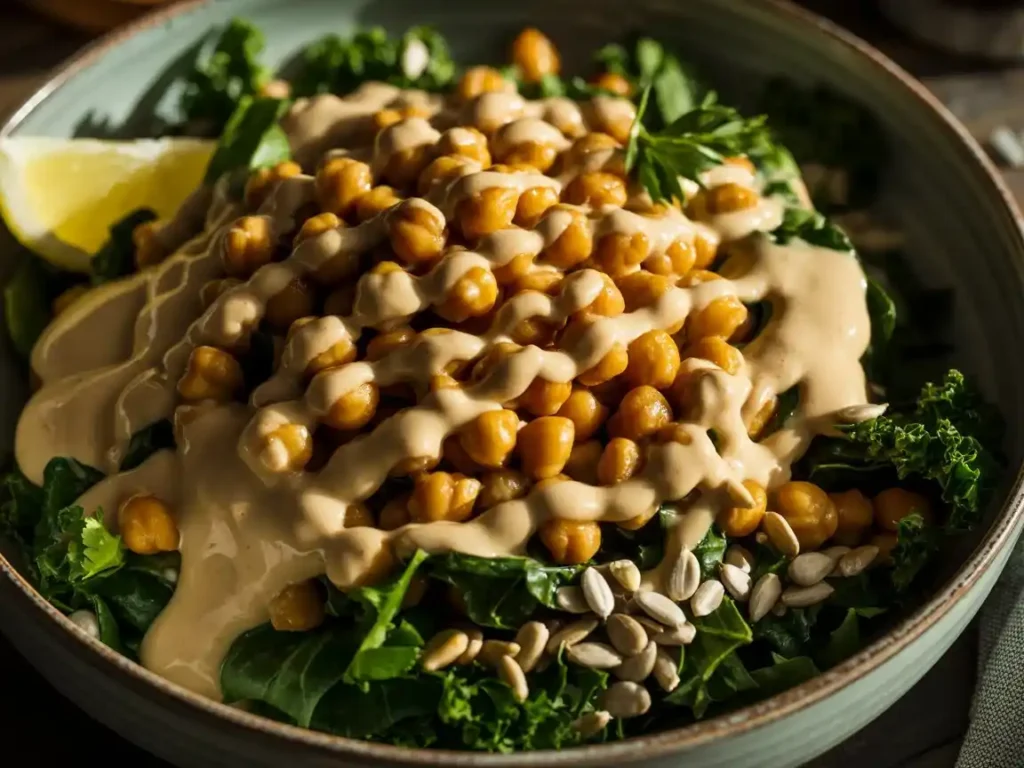
The Protein Layer — Indulgent Without Guilt Roasted chickpeas deliver the indulgent bite. Drain, rinse, and pat them completely dry before roasting at 200°C (400°F) for twenty-five minutes with a drizzle of olive oil, smoked paprika, garlic powder, and salt. They emerge golden, crisp on the outside, and creamy at the center — a texture that genuinely satisfies the craving for something substantial.
The Crunch Layer — Textural Strategy Toasted sunflower seeds or shaved watermelon radish add the final textural contrast. This is not a garnish decision — it is a satiety strategy. A bowl with uniform texture registers as less satisfying to the palate than one with deliberate contrast. The crunch signals completion.
The Bold Finish — Herbs, Acid, and Heat Fresh flat-leaf parsley, a pinch of smoked paprika, and a fine grating of lemon zest applied at the very end. Acid brightens fat. Heat deepens the creamy base. Herbs lift the entire bowl. This finishing layer is the single biggest upgrade most home cooks skip, and it is the difference between a salad that tastes fine and one that tastes bold.
Full Ingredient List
| Ingredient | Quantity |
|---|---|
| Massaged kale or shredded cabbage | 3 cups |
| Canned chickpeas (drained, dried) | 1 can (400g) |
| Tahini | 3 tbsp |
| Fresh lemon juice | 2 tbsp |
| Garlic clove, grated | 1 |
| Apple cider vinegar | ½ tsp |
| Smoked paprika | ½ tsp |
| Toasted sunflower seeds | 2 tbsp |
| Fresh flat-leaf parsley | small handful |
| Lemon zest | ½ lemon |
| Olive oil | 1 tbsp |
| Salt and black pepper | to taste |
Naturally gluten-free, dairy-free, and vegan. Swap chickpeas for edamame for a higher-protein variation.
Step-by-Step Instructions
Step 1 — Build the Dressing
Combine tahini, lemon juice, grated garlic, apple cider vinegar, and salt in a small bowl. Whisk vigorously for ninety seconds. Add cold water one tablespoon at a time, continuing to whisk, until the dressing emulsifies into a smooth, glossy consistency that holds a ribbon when lifted on a spoon.
Pro-Tip: Cold water is non-negotiable here. Hot or warm water breaks the emulsification and produces a thin, separated dressing. Add it slowly — patience at this stage determines the entire bowl.
Step 2 — Massage the Base and Pre-Marinate
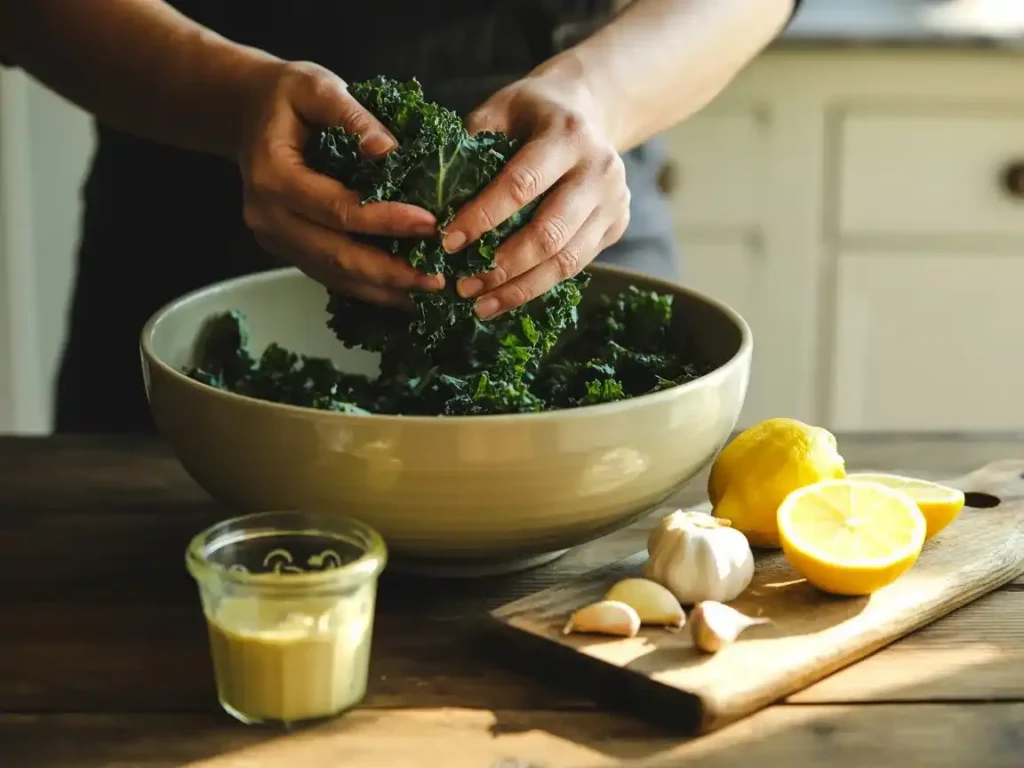
Add kale or shredded cabbage to a large bowl. Spoon one tablespoon of the prepared dressing directly onto the greens and use your hands to massage firmly for two full minutes until the leaves darken, soften, and reduce in volume by roughly a third.
Pro-Tip: Massaging with the dressing rather than plain oil pre-marinates the greens from the inside. Every leaf absorbs flavor before the bowl is even assembled — this is why the salad tastes bolder on day two than day one.
Step 3 — Roast the Chickpeas
Spread the thoroughly dried chickpeas on a baking tray in a single layer. Toss with olive oil, smoked paprika, garlic powder, and salt. Roast at 200°C for twenty-five minutes, shaking the tray once at the halfway mark, until deeply golden and crisp at the edges.
Pro-Tip: Moisture is the enemy of crispness. Pat the chickpeas with a clean kitchen towel until they feel almost chalky before they hit the tray. Any residual moisture steams them instead of roasting them.
Step 4 — Assemble in the Correct Order
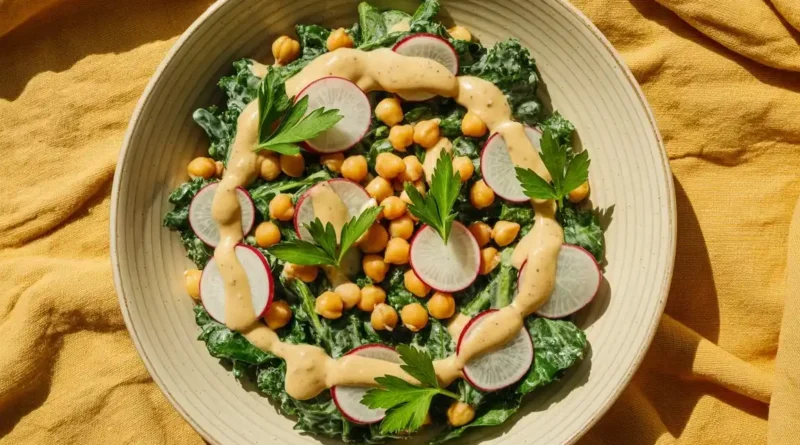
Layer the massaged greens first. Add the roasted chickpeas across the top. Scatter the toasted sunflower seeds and shaved radish. Drizzle the remaining dressing from the outside inward rather than dumping it in the center. Finish with fresh parsley and lemon zest.
Pro-Tip: Never bottom-load the dressing — it saturates the greens unevenly and collapses the textural structure within minutes. The outside-in drizzle distributes it across every element without drowning any single layer.
The Meal Prep Protocol
Store the dressing separately in a small jar. Keep the roasted chickpeas in an airtight container at room temperature (they stay crisp far longer than they do refrigerated). Assemble each portion fresh at your desk in sixty seconds flat — greens from the container, chickpeas from the jar, dressing drizzled on top. The massaged kale holds beautifully for five days. Nothing wilts. Nothing gets soggy. Nothing disappoints you at 12:30pm on a Friday.
Nutritional Callout (Per Serving, Approximate)
Calories: 380 | Protein: 14g | Fat: 18g | Fiber: 10g | Carbs: 38g
Notable micronutrients: Iron and Vitamin K from kale, calcium and zinc from tahini, anti-inflammatory compounds from smoked paprika and garlic.
Three Bold Variations
Mediterranean: Add Kalamata olives, sun-dried tomatoes, and a pinch of dried oregano to the base formula. Swap the smoked paprika for za’atar.
Southwest: Add roasted corn, black beans, and swap the tahini dressing for a cumin-lime tahini — same base, two tablespoons of lime juice replacing lemon, one teaspoon of cumin added to the whisk.
Asian-Inspired: Replace chickpeas with shelled edamame, add shredded red cabbage and thinly sliced cucumber, and build the dressing with grated fresh ginger and a teaspoon of toasted sesame oil folded into the tahini base.
Why This Works — The Gap Logic
Three things separate this bowl from every generic clean eating salad currently populating Pinterest: the dressing emulsifies rather than separates, the greens are structurally wilt-proof for the entire working week, and the protein-fat-fiber architecture keeps your hunger signal quiet for hours after the last bite. This is not a salad that asks you to suffer for your choices. It is a salad that is quietly, genuinely, indulgently good — and happens to be built entirely from whole, clean ingredients.
Made this bowl? Save it to your clean eating board and tag your version — I want to see how you layered it. And if you’re ready to build an entire week of lunches around this kind of thinking, the weekly meal prep system post covers every component in ninety minutes flat.


